
Xeryon vs other precision motion technologies
To move something small, fast and precisely you have several options: electromagnetic linear motors, a motor on a screw, or one of the piezo drive principles. Each buys one strength by paying with another.
This page compares them in three groups, because an actuator, a rotation stage and a linear stage solve different problems:
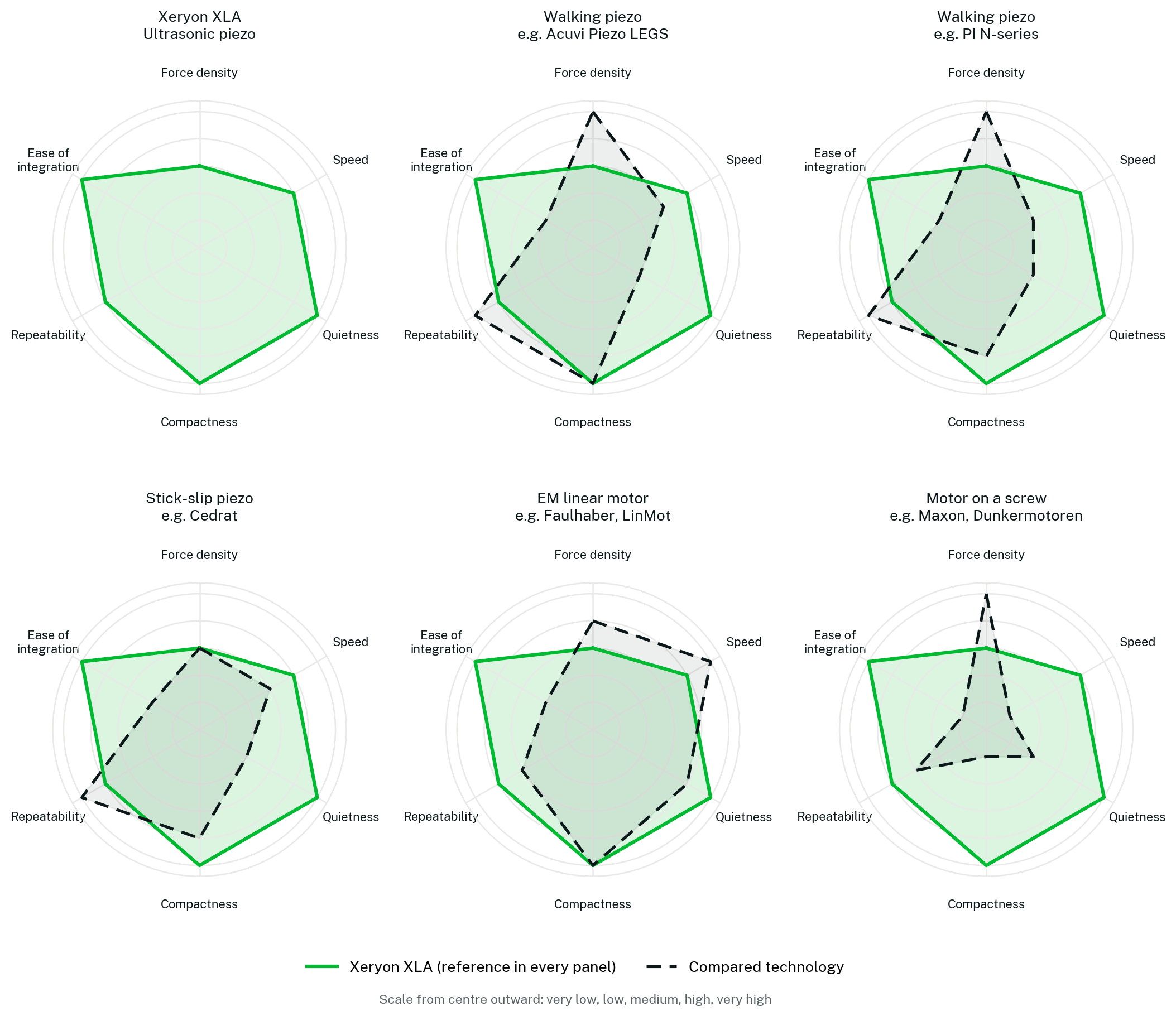
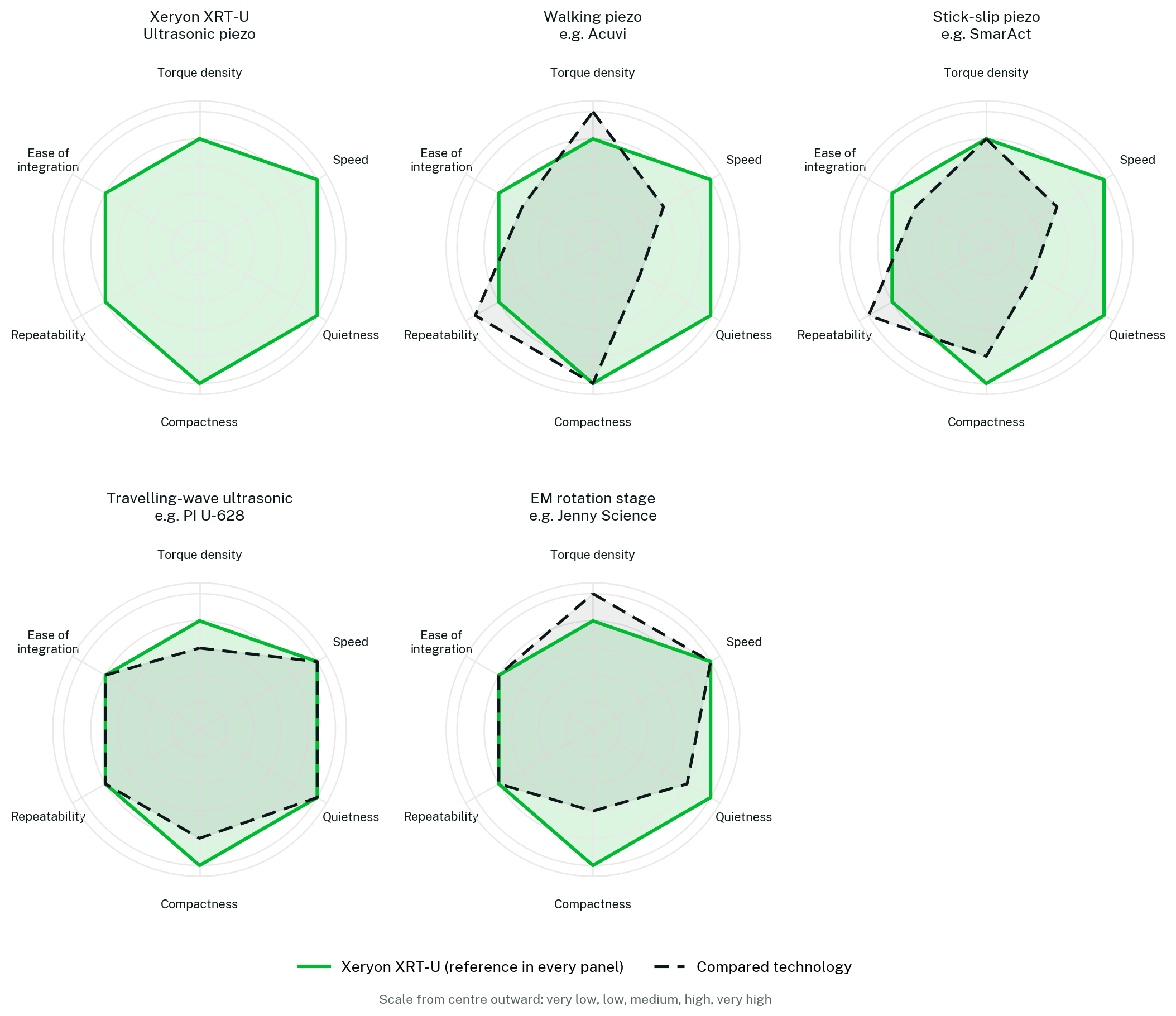
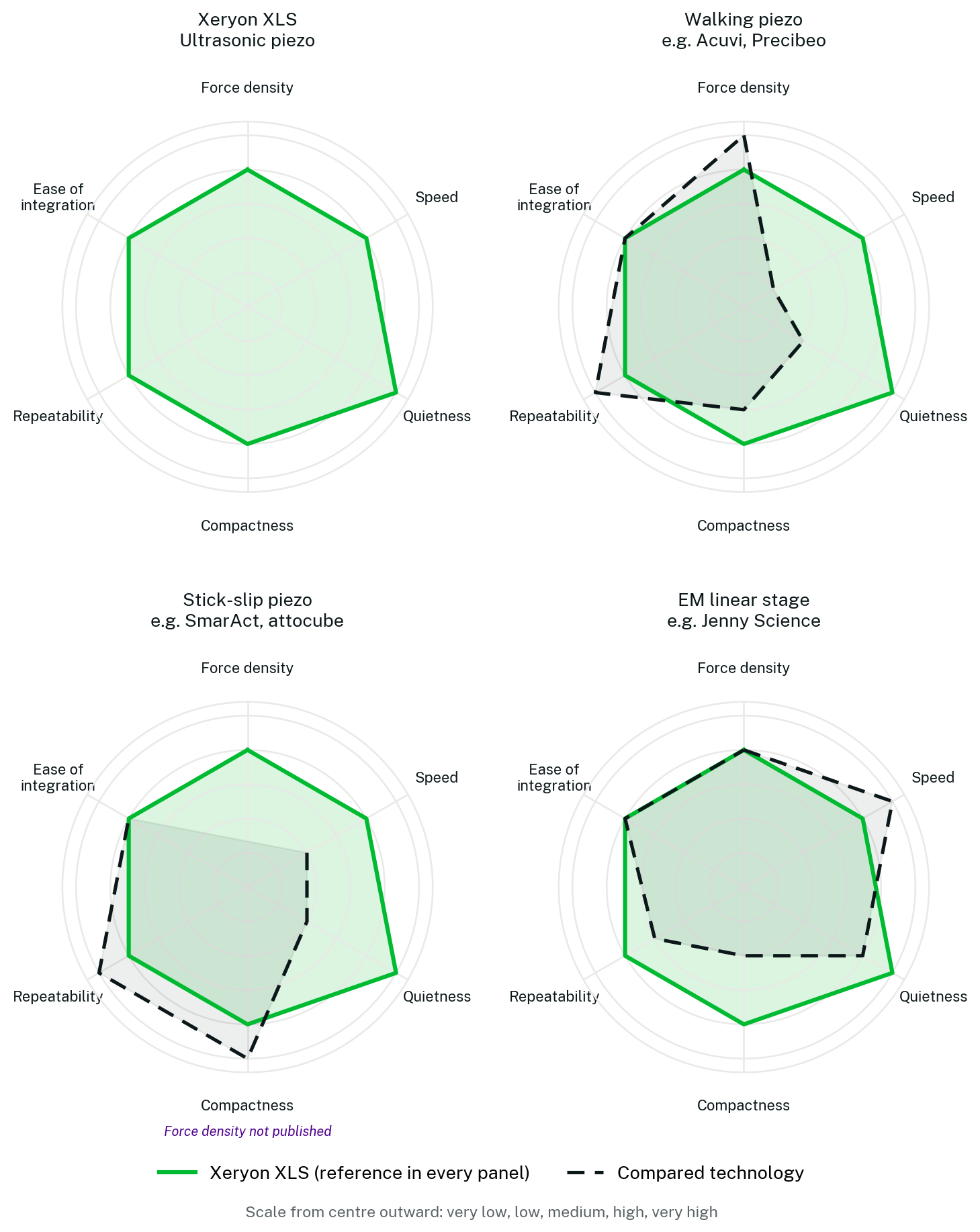
Each group is scored* on the same six criteria, from Very low to Very high. Higher is always better.
*About the calculation method:
every figure in these tables is one of three kinds, and the tables say which. Top speed, driving force and the dimensions behind installed volume are published supplier specifications. Force and torque density are calculated from those specifications, force or torque divided by volume. Repeatability is the published bidirectional figure, which is not the same quantity as absolute accuracy and not the same again as encoder resolution. Quietness and ease of integration are our qualitative assessment, not measurements. Within each group the three calculated and measured criteria go onto a logarithmic scale split into five equal bands, against every comparable product in our survey, between nineteen and twenty-six per group, not against the handful shown in the table. A band says where a technology ranks across the market we surveyed, not in absolute terms, and it is not an application score. No supplier among the sources we examined publishes a measured sound level, ours included, so every quietness score here is an argument from drive frequency.
Actuators
Most small linear actuators only push and pull, and the rod is unguided. Before that axis works you have added a linear guide, a mounting plate, a coupling and often an encoder. Xeryon’s XLA arrives guided, encoded and self-locking in one part. Mount it, connect it, move your payload. On suitable light payloads such as a mirror, a lens or a sensor it can replace a complete stage. Payload limits and the need for external guidance differ across the range, so check the mechanical integration guide for the model you are considering.
| Technology | Examples | Force density (N/dm³) | Speed (mm/s) | Quietness (qualitative) | Compactness (mm³) | Repeatability (bi-dir) | Ease of integration | Holds at power-off |
|---|---|---|---|---|---|---|---|---|
| Ultrasonic piezo, guided | Xeryon XLA | Medium (617) | High (400) | Very high | Very high (2 180) | High | Very high | Yes |
| Walking piezo | Acuvi Piezo LEGS | Very high (4 662) | Medium (24) | Usually low | Very high (5 180) | Very high | Low | Yes |
| Walking piezo | PI N-series | Very high (4 539) | Low (10) | Usually low | High (7 500) | Very high | Low | Yes |
| Stick-slip piezo | Cedrat | Medium (446) | Medium (30) | Usually low | High (6 732) | Very high | Low | Yes |
| Electromagnetic linear motor | LinMot, Faulhaber | High (793) | Very high (7 300) | High | Very high (2 112) | Medium | Low | No |
| Stepper or DC motor on a screw | MPS, Maxon | Very high (3 788) | Very low (1.4) | Low | Very low (132 000) | Medium | Very low | Lead screw yes, ball screw needs a brake |
Figures are the best released product per technology, at component level.
How the figures are picked.
Each criterion takes the best released product in that range. A row is therefore the envelope of a product family, not one model: here the 617 N/dm³ is the XLA-10 and the 2 180 mm³ is the XLA-1, and for Acuvi the 4 662 N/dm³ is the LT40 and the 5 180 mm³ the LT20. The same rule applies to every manufacturer, which keeps the rows comparable. No single part number reaches every corner of its own shape. Pick a model for a real application and you trade along the family: the XLA-1 is the small one at 1 N, the XLA-10 the strong one at 10 N.
A brand is not a drive principle.
Most suppliers in this comparison sell more than one drive principle. PI appears in these tables twice, once as walking piezo and once as a travelling-wave ultrasonic rotation stage. Read a row as a drive principle with an example product, never as a verdict on the supplier.
What ease of integration counts.
Parts you buy and interfaces you wire: whether the axis arrives guided, encoded and self-locking, and what it takes to talk to it. This comparison does not score how familiar the control electronics feel. A stepper on a screw is a well-understood drive with decades of reference designs behind it, and on that measure it is the easy option. It scores low here because it reaches the application as several separate parts.
Where the XLA stands out. At 2 180 mm³ the XLA-1 is the smallest piezo actuator here, less than half the volume of the nearest walking piezo motor. Top speed is 400 mm/s; walking and stick-slip drives sit between 10 and 30. Driving force comes in 1, 5 and 10 N, and the XLA-5 and XLA-10 also ship with an integrated controller. Bidirectional repeatability is 160 nm on the 78 nm encoder, against single-digit micrometres from a mainstream electromagnetic linear axis. Sub-micrometre electromagnetic stages do exist, at several kilograms and a different price class.
The trade. Walking piezo packs roughly seven and a half times the force into the same volume, 4 662 against 617 N/dm³. It buys that with speed: the XLA runs 400 mm/s, the walking piezo actuator about 24, a factor of seventeen. An electromagnetic linear motor of similar size pushes harder and moves eighteen times faster, but it draws current the whole time it holds position, and its rod is free to rotate, so you add a guide and a brake on any vertical axis. A screw drive is cheap. The guide, coupling and encoder turn one purchase into an assembly you design, source from several suppliers and debug yourself, and whether it holds at power-off depends on the screw: a lead screw normally self-locks, a ball screw back-drives and needs a brake on the motor shaft. The ultrasonic drive needs none of that. It self-locks at rest with a holding force equal to its driving force and draws no current to stay put. That is passive holding within the specified holding force, not a safety brake, so size the axis on the load you need to hold and not only on the load you need to move.
What counts as volume
Force density depends entirely on which volume you divide by. A bare piezo motor has no guide, no encoder and no drive electronics inside its envelope. A guided, encoded actuator has all three. Counting the controller changes the figure by up to a factor of twenty:
| Product | Component only (N/dm³) | Including controller | Retained |
|---|---|---|---|
| XLA-1 | 459 | 23 | 5% |
| XLA-5 | 436 | 94 | 21% |
| XLA-10 | 617 | 172 | 28% |
| XLA-5 integrated controller | 327 | 327 | 100% |
| XLA-10 integrated controller | 348 | 348 | 100% |
| XLS-3-120 | 31 | 22 | 70% |
| XRT-U-60 | 476 mNm/dm³ | 389 mNm/dm³ | 82% |
| XRT-U-25 | 1 898 mNm/dm³ | 365 mNm/dm³ | 19% |
The smaller the moving part, the more the external controller dominates installed volume, which is why the integrated-controller variants keep their full figure. The component-level scores above compare a complete axis with a bare motor, so they understate every integrated product, ours included.
Rotation stages
For rotation the choice usually comes down to space. An electromagnetic rotation stage is fast, strong and accurate, and larger. Once the envelope tightens you are at piezo, and most piezo rotation either steps slowly or stops at a limited angle. The XRT-U turns continuously, at speed.
| Technology | Examples | Torque density (mNm/dm³) | Speed (°/s) | Quietness (qualitative) | Compactness (mm³) | Repeatability (bi-dir) | Ease of integration | Rotation range |
|---|---|---|---|---|---|---|---|---|
| Ultrasonic piezo | Xeryon XRT-U | High (1 898) | Very high (1 080) | Very high | Very high (10 012) | High | High | Continuous 360° |
| Walking piezo | Acuvi Piezo LEGS | Very high (6 488) | Medium (30) | Usually low | Very high (4 624) | Very high | Medium | Limited angle |
| Stick-slip piezo | SmarAct | High (1 705) | Medium (30) | Usually low | High (17 600) | Very high | Medium | Continuous |
| Travelling-wave ultrasonic | PI U-628 | Medium (526) | Very high (720) | Very high | High (47 500) | High | High | Continuous 360° |
| Electromagnetic motor | Jenny Science | Very high (7 459) | Very high (1 300) | High | Medium (136 750) | High | High | Continuous 360° |
Where the XRT-U stands out. The XRT-U-25 turns at 1 080 °/s and the XRT-U-30 at 720 °/s, thirty-six times the walking and stick-slip alternatives, with encoder resolution down to 3 µrad and continuous rotation instead of a limited angle. At 10 012 mm³ the XRT-U-25 is the smallest closed-loop rotation stage here, bare walking piezo motors aside.
The trade. Walking piezo delivers 6 488 mNm/dm³ against 1 898. For pure holding torque in a small envelope it is ahead. PI’s travelling-wave stage matches the XRT-U on drive principle and reaches 720 °/s, in a package roughly five times the volume.
Linear stages
Linear stages are the most crowded group. Almost every supplier ships encoded, closed-loop stages, so closed-loop is no longer the differentiator. Speed, travel, noise and size are.
| Technology | Examples | Force density (N/dm³) | Speed (mm/s) | Quietness (qualitative) | Compactness (mm³) | Repeatability (bi-dir) | Ease of integration | Holds at power-off |
|---|---|---|---|---|---|---|---|---|
| Ultrasonic piezo | Xeryon XLS | High (156) | High (200) | Very high | High (17 680) | High | High | Yes |
| Walking piezo | Acuvi LPS, THK, Precibeo | Very high (476) | Very low (15) | Usually low | Medium (28 350) | Very high | High | Yes |
| Stick-slip piezo | SmarAct, attocube | Not published | Low (20) | Usually low | Very high (4 128) | Very high | High | Yes |
| Electromagnetic motor | Jenny Science | High (192) | Very high (2 000) | High | Low (124 800) | Medium | High | Brake needed |
Where the XLS stands out. 200 mm/s against 15 to 20 mm/s for the piezo alternatives, a factor of ten to thirteen. Travel runs 10 to 110 mm, encoder options go from 5 to 1 250 nm, and the stage holds position without power.
The trade. Driving force is 1 to 5 N and payload up to 1.5 kg. Lifting heavy loads on a vertical axis is outside that envelope. Stick-slip stages are smaller, 4 128 against 17 680 mm³. An electromagnetic stage is ten times faster in a package seven times the size, and a mainstream one gives up an order of magnitude on repeatability to get there.
How the drive technologies differ
“Piezo motor” covers several drive principles. They behave nothing alike.
Ultrasonic piezo (Xeryon). A ceramic tip oscillates above human hearing and pushes the runner by friction, directly, with no screw and no gearing. There is no drive tone, and the motor holds position at power-off. What can become audible is the friction contact itself, not the drive frequency, and that shows up at crawling speed. The cost is force: less of it than walking piezo or an electromagnetic motor.
Stick-slip piezo. A sawtooth voltage creeps the carriage forward by friction, then snaps back fast enough to leave it in place. The steps are fine, travel is slow, and the contact wears continuously. Step rates land in the audible band, so the stepping is often heard; one supplier sells a firmware mode that shifts the step frequency out of human hearing. That is implementation, not principle. Sensapex, for one, is quiet.
Walking piezo. Pairs of piezo legs clamp and push a drive rod in turn. No drive here packs more force or more holding force into the same volume. It is also slow, and it walks at a few kilohertz, which puts it in the audible band while it moves.
Travelling wave piezo. A wave runs around a ceramic ring and turns a rotor. Used for rotation only, it reaches speeds in the same class as the XRT-U.
Electromagnetic linear motor. Coils and permanent magnets produce force directly. Strong and fast. It draws current and dissipates heat to hold position, and it carries a magnetic field into your instrument.
On wear and lifetime. Every friction drive wears at the contact, ultrasonic included. What decides lifetime is duty cycle, load, travel and environment, so compare published lifetime figures with their test conditions rather than comparing drive principles.
One supplier for actuators, rotation and linear stages
Many instruments need a linear axis, a rotation and a small actuator. Xeryon supplies all three on the same drive principle and the same controllers, over USB, RS232, EtherCAT, CANopen and UART, with libraries for Python, C++ and LabVIEW. One XD-M drives up to six axes.
Not sure which technology fits your payload, stroke and space? Send us your requirements and an engineer will check them against our envelope.
FAQ
Aren’t piezo motors slow and noisy?
Stick-slip and walking piezo drives are slow, 10 to 30 mm/s in this comparison, and they step inside the audible band, so you often hear them. Some implementations are quiet. An ultrasonic motor drives the runner continuously above human hearing: an XLS stage reaches 200 mm/s and an XLA actuator 400 mm/s, with no drive tone.
What is the difference between ultrasonic and stick-slip piezo motors?
Both drive by friction. Stick-slip moves in sawtooth steps: slow, continuously wearing the contact, and audible whenever the step rate sits inside the audible band. Ultrasonic piezo drives the runner with a continuous oscillation above hearing, roughly ten times faster and with no drive tone. Step rate decides audibility, not the word piezo. A well-engineered stick-slip stage can be quiet too.
Why does walking piezo score higher on force density?
Walking piezo packs more force into less volume, 4 662 against 617 N/dm³ at component level. It pays with speed, roughly 24 mm/s against 400, and with stepping you usually hear. And it still needs an external controller, a guide and an encoder before it is an axis. None of those sit inside that volume.
When is an XLA a better choice than an electromagnetic linear motor?
When space is tight, the axis has to hold position without power, and you need sub-micrometre repeatability without a jump in size. The XLA arrives guided and self-locking, so no external guide and no brake. An electromagnetic linear motor gives you more force and far more speed. It also draws current to hold, needs a guide around its rod, and the mainstream models land in single-digit micrometres on repeatability.