
Ultrasonic Piezo vs Conventional Motion Technologies: Comparing Size, Precision, Speed and Durability
When designing modern high-tech instruments, engineers often face the same core challenge: achieving precise and repeatable positioning in a limited mechanical space. Precision motion systems must deliver repeatable movement, high resolution, stability and long service life, while still fitting into compact instruments, OEM modules or automated machines.
In many applications, the motion system is not just a mechanical component. It directly affects the performance of the full system. If the actuator or stage introduces backlash, vibration, wear, drift or excessive heat, the entire instrument can lose accuracy over time.
This is especially important in industries where motion control must be compact, precise and reliable:
- Photonics and optical alignment: Applications such as fiber alignment, laser technology, optical metrology and interferometry require precise positioning of optical components. Even small positioning errors can reduce coupling efficiency, affect measurement stability or cause signal loss.
- Semiconductor manufacturing and inspection: Wafer inspection, lithography-related tools and metrology systems require smooth, repeatable and highly stable motion. In these environments, precision, cleanliness, compactness and long-term reliability are critical.
- Microscopy and biomedical instruments: Automated microscopes, imaging systems, diagnostic devices and laboratory instruments increasingly need industrial-level precision in a compact desktop format. Large conventional motors and bulky mechanics are often difficult to integrate.
- Precision automation and OEM equipment: Machine builders need motion control technologies that are compact, durable, easy to integrate and capable of maintaining accuracy over many cycles.
To compare available motion technologies, it is useful to look at four key engineering parameters: size, precision, speed and durability. The following comparison explains where traditional motion systems are typically used, where their limitations appear, and how ultrasonic piezo motion technology fits into compact high-precision positioning systems.
Positioning Technologies: Size vs Precision
The first comparison looks at different positioning technologies and how they balance positioning performance with overall mechanical envelope. The chart gives a qualitative view of where different motion technologies are typically positioned when precision and size are considered together.
While the focus of this comparison is on compact precision positioning, the chart also includes a rotary voice coil actuator as a reference for voice-coil-based direct-drive motion. This helps illustrate how different actuator principles can vary in size, integration complexity and positioning behavior.
Larger Direct-Drive Motion Systems
Magnetic linear stages are shown in the very precise area of the chart. Their main advantage is smooth, direct-drive linear motion, which makes them suitable for demanding applications where high positioning performance, stable motion and larger travel ranges are required.
However, this performance is usually achieved with a larger mechanical structure. In the chart, the magnetic stage is positioned further to the right
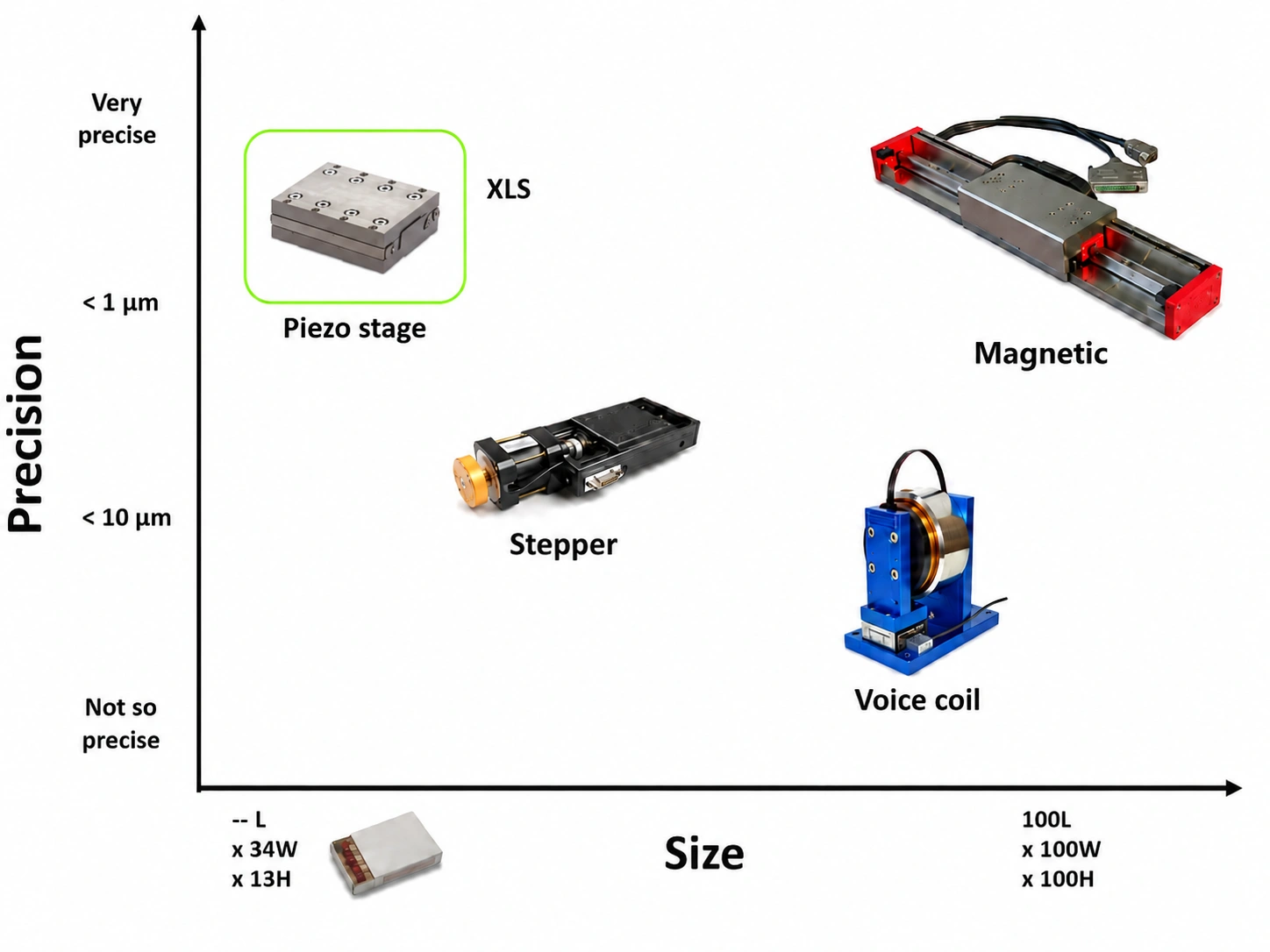
because it occupies significantly more space than compact piezo-based positioning systems. This makes magnetic stages a strong option when system size is less constrained, but less ideal when the motion system must fit into a very compact instrument or OEM module.
The voice coil actuator shown in the chart represents a rotary or limited-angle voice coil configuration. Voice coil actuators are useful when fast, smooth and responsive motion is required, especially in applications where dynamic behavior is important. However, depending on the required motion type, stroke or rotation angle, force, guidance and feedback, the complete voice coil assembly can become difficult to integrate in compact systems.
This is why the voice coil example is positioned on the larger side of the comparison. It should be understood as a reference for voice-coil-based motion technology, rather than as a direct linear stage equivalent.
Stepper-Based Linear Positioning Systems
Stepper-based systems are positioned in the middle area of the chart. They are widely used because they are familiar, robust and relatively easy to implement.
In most linear positioning systems, however, the rotary motion of the stepper motor must be converted into linear movement through a screw, belt, nut or another transmission mechanism. These additional components can increase the size of the system and may introduce friction, backlash, wear or mechanical complexity. This is why stepper-based solutions are shown outside the most compact and highest-precision area of the comparison.
Ultrasonic Piezo Linear Stages
The XLS piezo stage is positioned in the compact and high-precision area of the chart. Its position highlights the key advantage of ultrasonic piezo linear stages: precise linear positioning in a small mechanical envelope.
The chart does not suggest that the XLS is the highest-precision option in every possible application. Instead, it shows the practical trade-off between precision and size. Magnetic linear stages can also achieve very high positioning performance, but they require more space. Stepper-based systems and voice-coil-based motion solutions can be useful in specific applications, but they often require additional mechanical components, guidance or a larger assembly to achieve the desired motion performance.
For applications where compact integration, low mechanical complexity and precise linear positioning need to be balanced, Xeryon's XLS piezo linear stage provides a compact alternative to larger motion technologies.
Rotary Positioning: Compact Precision vs Mechanical Complexity
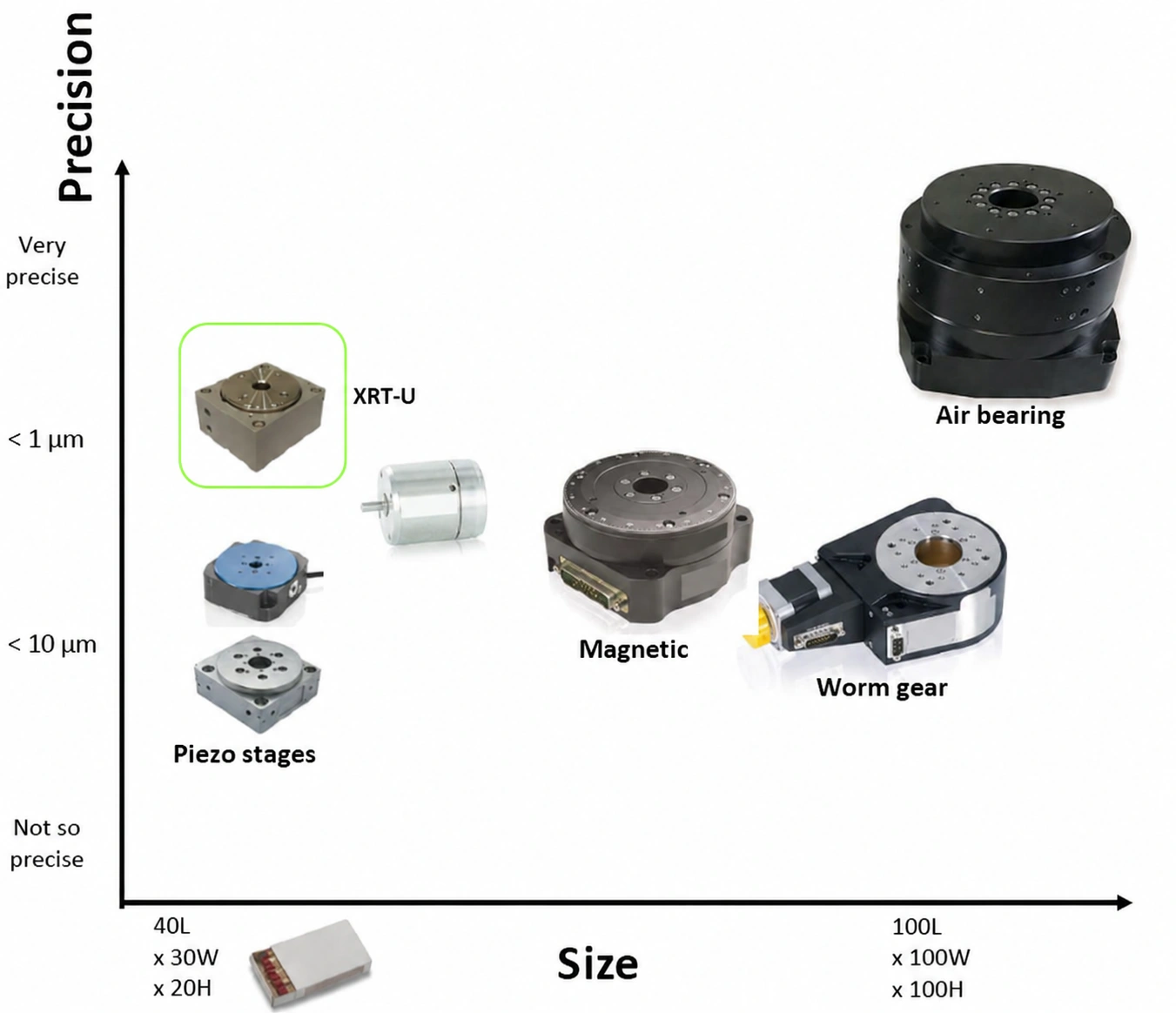
The second comparison focuses on rotary motion technologies. In rotary positioning, engineers must control not only angular movement, but also mechanical errors such as runout, wobble, stiffness and repeatability. These parameters are critical in optical instruments, metrology systems, microscopy, semiconductor tools and precision automation.
Air Bearing Rotary Stages
Air bearing rotary stages are often associated with extremely high precision. Because the rotating element is supported by a thin film of air, friction is very low and motion can be exceptionally smooth.
However, air bearing systems are usually large, expensive and dependent on external pneumatic infrastructure. This makes them difficult to integrate into compact OEM instruments or portable systems.
Worm Gear and Magnetic Rotary Systems
Worm gear rotary stages can provide high torque and self-locking behavior, but they rely on mechanical contact between gear teeth. Over time, this can introduce wear, backlash and changes in positioning behavior. For applications that require long-term repeatability, this mechanical wear can become a limiting factor.
Magnetic rotary systems can provide direct-drive motion and good dynamic performance, but they are often larger and more expensive. They may also be less suitable for applications where magnetic fields must be avoided or where a very compact mechanical design is required.
Ultrasonic Rotary Piezo Stages
Ultrasonic rotary piezo stages, such as Xeryon XRT-U stages, are shown in the compact and precise region of the comparison. They are designed for applications where small size, precise angular positioning and stable rotary motion are required.
Compared with larger rotary technologies, ultrasonic piezo rotary stages offer a compact alternative for engineers who need precise angular positioning without building a large mechanical system around the motor. This makes them relevant for optical alignment, microscopy, inspection systems, compact automation and other precision instruments where every millimeter of space matters.
Piezo Motion Technologies: Speed vs Durability
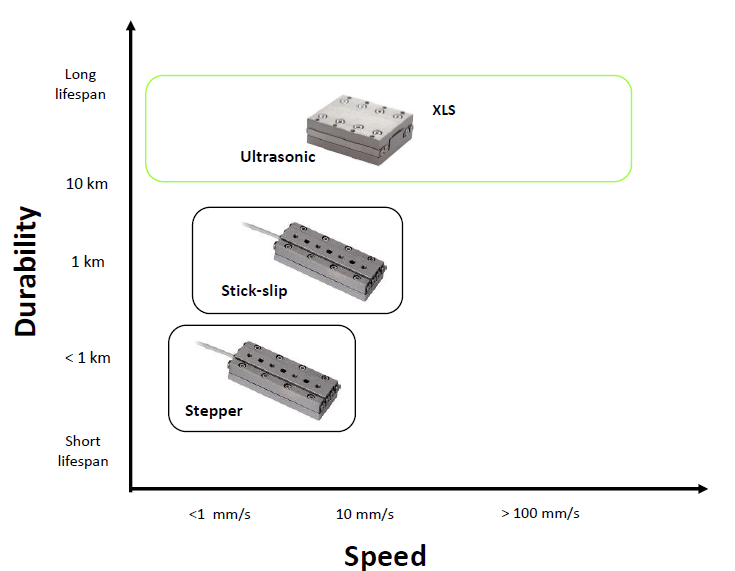
Not all piezo motion systems work in the same way. The third comparison focuses specifically on different piezo-based motion technologies and compares their speed and durability.
Piezo Stepper Systems
Piezo stepper systems usually operate by clamping and releasing mechanical elements in a sequence. This enables very fine movement, but the motion principle can limit speed and may introduce mechanical stress over many cycles. In this qualitative comparison, piezo stepper technology is positioned in the lower-speed and shorter-lifetime range.
Stick-Slip Piezo Motors
Stick-slip piezo motors, also known as inertia piezo motors, use the difference between static and dynamic friction to create motion. They move by rapidly sticking and slipping against a surface.
This technology can achieve compact and precise motion, but the repeated slip behavior can lead to wear and may limit lifetime in high-duty-cycle applications. Stick-slip systems are often used for compact fine positioning where speed and duty cycle are less demanding.
Ultrasonic Piezo Motors
Ultrasonic piezo motors use a different operating principle. Xeryon’s ultrasonic piezo motor creates an elliptical motion at high frequency. This motion drives the stage or motor through controlled contact, enabling fast and precise movement.
In this qualitative comparison, ultrasonic technology is positioned above stick-slip and piezo stepper systems in both speed and expected durability. This is one of the main reasons ultrasonic piezo stages or motors are relevant for precision motion applications that require more than small positioning steps. They can support both fine positioning and fast travel, making them useful when engineers need compact size, speed and long service life in one motion system.
For OEM motion control, this is especially important. A motion component may perform well in a datasheet, but the real test is whether it can maintain performance over extended operation inside an integrated machine. Durability, repeatability and low wear are therefore just as important as resolution.
Rotary Motion Technologies: Durability vs Cost
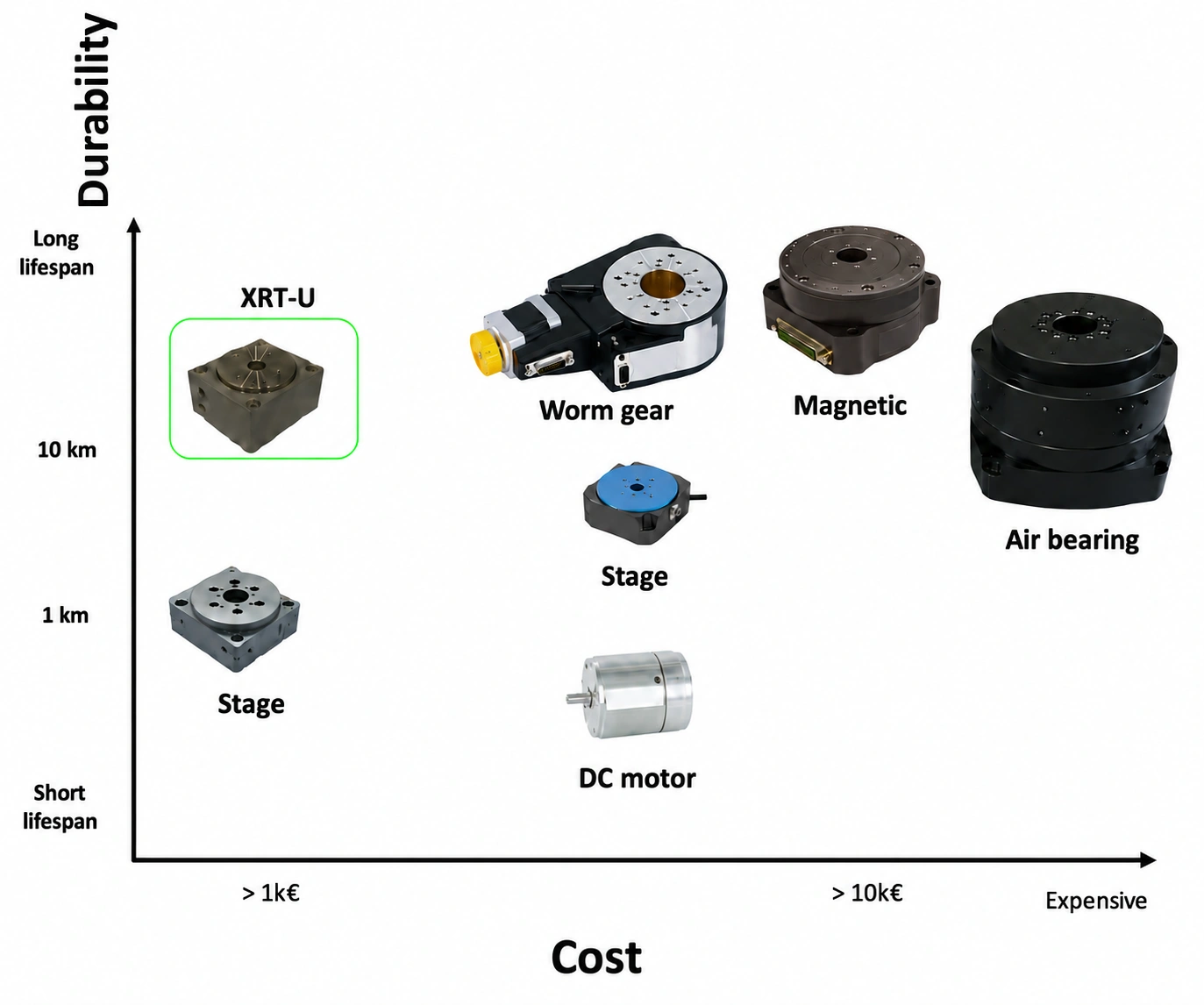
The fourth comparison looks at rotary motion technologies from the perspective of cost and durability. This is important because the best technical solution is not always the best system-level solution. Engineers and product teams often need to balance performance, cost, integration complexity and long-term reliability.
High-Precision Rotary Technologies
Air bearing stages can provide excellent precision and long lifetime, but they are typically positioned in the high-cost area. In addition to the stage itself, they may require external air supply, filtration, maintenance and additional system infrastructure.
For some laboratory or metrology systems, this cost is justified. For compact OEM machines or scalable production equipment, it may be difficult to justify.
Magnetic rotary stages and advanced direct-drive systems can also offer strong performance, but they are often larger and more expensive. Their integration may require additional feedback systems, control electronics and mechanical space.
Mechanical Wear and Total Cost of Ownership
Worm gear solutions can be more accessible than air bearings or advanced magnetic systems, but they introduce mechanical contact and wear. Over time, this can affect backlash, repeatability and maintenance requirements.
Xeryon’s ultrasonic rotary piezo stages are positioned in the comparison as compact solutions with a favorable relationship between durability and cost. The XRT-U is shown in a long-lifetime region at a lower cost range than larger premium rotary technologies.
From a total cost of ownership perspective, this matters because the initial purchase price is only one part of the equation. Engineers also need to consider maintenance, downtime, replacement cycles, integration time, footprint and energy consumption. A compact, low-wear, direct-drive motion system can reduce system complexity and improve long-term value.
Key Engineering Criteria for Motion System Selection
System integrators and OEM engineers usually do not select a motion system based on one parameter alone. They need to balance multiple requirements at the same time:
- required positioning resolution
- available mechanical space
- stroke or rotation range
- speed and acceleration
- duty cycle and expected lifetime
- backlash and repeatability
- heat generation and power consumption
- magnetic compatibility
- cleanliness and vacuum compatibility
- controller integration
- total cost of ownership
Traditional motion technologies often require trade-offs. A stepper system may be cost-effective but larger. A voice coil may be fast but require continuous power to hold position. An air bearing may be extremely precise but too large or expensive. A worm gear may be compact but can wear over time.
Backlash and Mechanical Complexity
Backlash is the lost motion that appears when a mechanical transmission changes direction. It is common in screw drives, gears and other mechanical transmission systems. In precision automation, backlash can reduce repeatability, increase settling time and create positioning errors.
Direct-drive motion technologies, including ultrasonic piezo motors, reduce the number of mechanical transmission elements and can therefore help minimize backlash in compact positioning systems.
This is especially relevant when comparing piezo linear stages with stepper-driven linear stages. Stepper-driven stages remain useful for many industrial applications, but they often require screws, bearings and additional mechanics to reach high precision. A piezo linear stage is a strong option when the system requires compact size, sub-micron positioning, fast positioning and low mechanical complexity.
Compact Integration in High-Precision Instruments
Ultrasonic piezo motors can help reduce overall system size because they create motion directly at the stage or rotor. This reduces the need for bulky transmission components such as gearboxes, screw drives or large electromagnetic assemblies.
As a result, engineers can design smaller motion modules while maintaining high positioning performance. In compact instruments, this can free up valuable space for optics, sensors, electronics or sample handling components.
Ultrasonic piezo stages are especially relevant when compact integration, repeatable positioning, high precision and long lifetime are important. They are used in applications such as photonics, semiconductor inspection, microscopy, metrology, medical devices and precision automation. Their compact form factor makes them suitable for instruments where conventional motors would take too much space.
Key Takeaways for Precision Motion System Selection
Every precision motion application has its own combination of load, travel range, speed, duty cycle, environmental constraints and integration requirements. Selecting the right motion technology requires more than comparing datasheet values. Engineers also need to evaluate how the system will perform once integrated into the final machine.
For compact high-precision systems, the main selection factors are usually size, positioning accuracy, speed, durability, backlash, integration complexity and long-term stability. Stepper systems, voice coil actuators, magnetic drives, worm gears and air bearing stages can all be suitable depending on the application, but each technology introduces different trade-offs.
Ultrasonic piezo motion technology is relevant when compact size, precise positioning, fast motion and low mechanical complexity are required in one motion system. It can be especially useful in applications such as photonics alignment, semiconductor inspection, microscopy, metrology, medical devices and precision automation, where space and repeatability are critical.
The best choice depends on the real operating conditions of the system. Engineers should compare not only nominal precision or speed, but also duty cycle, expected lifetime, mechanical complexity, available installation space and the effect of the motion system on overall machine performance.